


The new Lithium. Class.
The combination of extreme performance and minimal weight.
At Banner, we are convinced that lithium technology is key to the energy solutions of the future. With five new Traction Bull Bloc Lithium models, we are expanding our portfolio for leisure, recreational vehicles, and solar applications.
Thanks to modular, standardized battery systems and tailor-made solutions, we reliably meet a wide range of customer requirements.
Banner premium quality. Noticeably different. Visibly better.
An overview of our product range


Exceptional Cycle Stability
Modern lithium-ion cells achieve well over 5,000 charge cycles at 50% depth of discharge (DoD), providing a significantly longer service life.
Ultra-lightweight construction
Up to 80% lighter than lead-acid batteries. This provides additional payload capacity and optimized space utilization.
Low self-discharge
Excellent shelf life and ideal for many applications.
Fast charging times
Short charging times ensure maximum availability and minimize downtime.
Integrated Battery Management System (BMS)
The integrated Battery Management System (BMS) ensures maximum safety, while real-time Bluetooth monitoring provides full transparency of the battery’s status at all times.
Reliable Even in Cold Weather
The integrated heating function in selected models ensures safe and reliable operation even in cold environments.
Benefits at a Glance
The built-in battery management system (BMS) ensures maximum safety.
Real-time Bluetooth monitoring provides app-based access to key information about the battery status.
Available for free on the Google Play Store and the Apple App Store.
FAQ: Traction Bull Bloc Lithium
General
These are a specific type of lithium-ion battery, specifically lithium iron phosphate batteries. The chemical formula LiFePO₄ consists of the elements lithium (Li), iron (Fe), and phosphate (PO₄), and is often abbreviated as LFP.
Banner Batterien Traction Bull Bloc Lithium batteries are specifically designed for cyclic operation as deep-cycle batteries and are not intended for use as starter batteries. This makes them ideal for hobby and recreational applications, particularly for camping and caravanning, boating and marine applications, balcony power plants, and stationary energy storage systems. They provide portable power in the form of “power to go” for sailboats, electric boats, and yachts, as well as for motorhomes and recreational vehicles, and also serve as mover batteries (maneuvering aids for trailers). In addition, they are used for storing solar and wind energy, in signaling systems, and as drive batteries for electrical consumers in the recreational and low-voltage sectors.
Lithium-Bull batteries are equipped with an integrated battery management system (BMS). This system continuously monitors charging and discharging processes and reliably protects the battery against overvoltage, undervoltage, overcurrent, and overtemperature. In addition, the system features built-in short-circuit protection. The integrated cell balancing ensures that all individual cells have as identical a state of charge as possible and balanced cell voltages.
Yes, it is generally possible to switch to a different battery technology. However, the required peak currents and the charging voltage of the alternator (generator) or the solar charge controller must be taken into account. Especially in vehicles with an alternator, it must be ensured that it is suitable for use with LiFePO₄ batteries or is adequately protected by using a suitable charge booster.
Tip: It is strongly recommended to check the entire system. Depending on the specific application, it may be necessary to adapt or modify chargers, charge controllers, charge boosters, inverters, wiring, relays, or fuses.
Yes, LiFePO₄ batteries can be operated in any orientation. They can be installed either upright or on their side. Installation upside down is generally not intended and is permitted only if expressly approved by the manufacturer.
Technology
A 12-V LiFePO₄ battery consists of four lithium iron phosphate cells connected in series, each with a nominal voltage of approximately 3.2 V. Depending on the desired capacity, additional cells may be connected in parallel.
The batteries use prismatic LiFePO₄ cells, which are characterized by exceptionally high cycle stability and excellent mechanical stability.
The cell balancing function is an essential component of the Battery Management System (BMS). It ensures that the individual lithium cells maintain as uniform a state of charge as possible and comparable cell voltages during charging and operation. This forms the basis for optimal performance, maximum safety, and a long battery life.
Temperature monitoring is an essential component of the battery management system (BMS). The battery automatically shuts down if the temperature becomes too high or too low to prevent damage. All Banner lithium-ion batteries have a discharge temperature range of −20°C to +60°C. The optimal ambient temperatures during charging vary by model:
- LFP 12-80 BL and LFP 12-100 BL (with heating function): −20°C to +60°C
- LFP 12-50 BL, LFP 12-75 BL, and LFP 12-150 BL (without heating element): 0°C to +60°C
For storage, a dry, cool location with temperatures between +10°C and +25°C is recommended. According to the technical data sheets, the maximum permissible storage temperature is between −5°C and +35°C. Extreme temperatures can significantly reduce the battery’s service life.
Overvoltage monitoring is a key component of the Battery Management System (BMS). If a defined maximum battery voltage is exceeded during charging, the BMS automatically shuts down the battery to protect it. The overvoltage threshold is approximately 14.6 V.
Undervoltage monitoring is an essential component of the Battery Management System (BMS). If the battery voltage drops below a defined minimum value, the BMS automatically shuts down the battery to prevent deep discharge. Depending on the battery type, the undervoltage threshold is approximately 10 V.
Overcurrent monitoring is a key component of the Battery Management System (BMS). If the continuous or peak discharge current exceeds the permissible limits, the BMS automatically shuts down the battery to prevent damage. The maximum permissible charge and discharge currents depend on the specific battery type and are specified in the technical data sheets.
Reverse polarity protection is an integral part of the Battery Management System (BMS). If the system detects that the connection cables have been reversed or that the positive and negative terminals have been connected incorrectly, the power supply is immediately cut off to protect the battery and connected devices.
Short-circuit protection is a key component of the Battery Management System (BMS). If the system detects a short circuit within milliseconds, the power supply is immediately interrupted to protect the battery and connected devices. Please note: Additional fuses for line protection must still be installed.
The deep discharge protection prevents the battery from dropping below the minimum permissible cell voltage. The Battery Management System (BMS) also cuts off the power supply if the current draw is too high or if the temperature is outside the permissible range of −20°C to +60°C. Tip: Place the battery in a cool environment whenever possible and never near heat sources.
Please refer to the table for the following information:
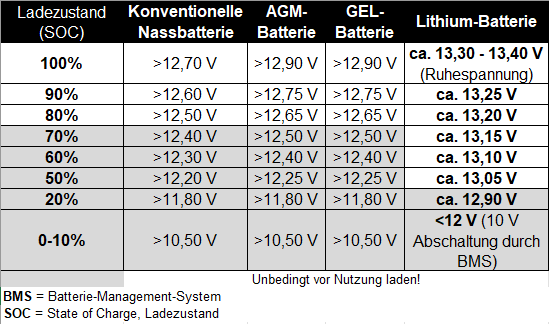
Wet, AGM, and GEL batteries: The voltage is measured at rest, without a load, and after a recovery period.
LiFePO₄ batteries: The voltage remains nearly constant over most of the state of charge, which is why the state of charge cannot be reliably determined based on voltage alone.
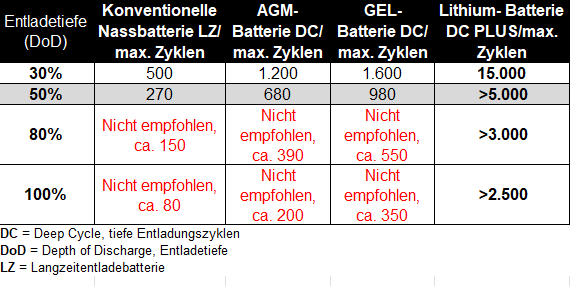
Please refer to the table for details.
The cycles listed can be tailored to different usage profiles and time periods. It would not be accurate to speak solely of a service life in years, as this could be misleading. In our case, one cycle (partial cycle, not full cycle) corresponds to a partial discharge of the battery to 50% remaining capacity (DoD), followed by a full recharge to 100% state of charge.
*Cycle life specifications are based on laboratory conditions (+25°C, defined charge and discharge currents, and full charge cycles). However, the actual service life of a battery depends significantly on the individual usage profile, operating temperatures, charging method, and depth of discharge.
Operating voltage:
The operating voltage refers to the battery voltage under load. For LiFePO₄ batteries, it typically ranges from approximately 13.3 to 12.8 V, depending on the load. The battery management system (BMS) ensures that the operating voltage remains constant for as long as possible, regardless of the battery’s state of charge. Therefore, a voltage measurement taken during operation provides only limited meaningful information about the actual state of charge.
Open-circuit voltage:
The open-circuit voltage of a fully charged LiFePO₄ battery (100% state of charge) is approximately 13.3 to 13.4 V. To reliably measure the open-circuit voltage, the battery should remain unused for several hours after charging is complete (internally via the alternator or externally via a charger), or no charging or discharging should take place for at least 1 hour.
Terminal voltage:
The terminal voltage is approximately 14.4 to 14.6 V and is particularly relevant for external charging via a fully automatic, voltage-regulated charger. For example, the AccuCharger model 15+25 A achieves a terminal voltage of 14.4 V. Charging programs with voltages above 14.6 V—such as boost, refresh, or reconditioning programs with voltages up to 16 V—are unsuitable for LiFePO₄ batteries and must not be used, as they can damage the battery.
Cargo
Fully automatic, voltage-regulated chargers with LiFePO₄-specific or IU/IUa characteristics are ideal for LiFePO₄ batteries. The recommended final charging voltage is approximately 14.4–14.6 V. Within this voltage range, the integrated BMS, including cell balancing, operates optimally.
A classic continuous float charge, as is common with lead-acid batteries, is not required for LiFePO₄ batteries. However, a lower float voltage is permissible.
Important note: Charging programs with “Boost,” “Refresh,” “Recondition,” or other equalization charges that generate voltages above 14.6 V must not be used under any circumstances.
Recommended charging profile: CC-CV or CC.
Note: For more information, please refer to our specific charging tips.
Yes, LiFePO₄ batteries can be charged using solar panels without any problems. However, it is essential to use a suitable solar charge controller between the solar panel and the battery. We recommend modern MPPT* solar charge controllers with adjustable parameters for LiFePO₄ batteries. The controller must be set to the correct charging and cut-off voltages. Directly connecting the solar panels to the battery without a charge controller is not permitted.
*MPPT = Maximum Power Point Tracking: The charge controller adjusts the input voltage of the solar system so that the maximum power of the modules is utilized.
Wiring
Whether and to what extent LiFePO₄ batteries may be connected in parallel, in series, or in a combination of both depends on the specific battery management system (BMS) and the overall system.
For our 12V LFP battery packs, parallel connection is generally possible. However, the connection and installation steps described in the User Manual must be strictly followed (see the relevant sections on installation and battery connection).
Banner recommends a maximum configuration of:
up to 4 batteries in series, and up to 4 batteries in parallel.
For safe and long-lasting operation, the following points must be observed:
Only batteries of the same type and capacity may be used. Ensure that all batteries come from as uniform a production batch as possible and were purchased within a short period of time (ideally within one month).
Before connecting the batteries, they must be fully charged (CC/CV method), allowed sufficient time to rest to allow for voltage equalization, and kept in a similar temperature environment.
Recommended Procedure
First, establish the series connection (if applicable)
Then stabilize the system and let it rest briefly
Then perform the parallel connection
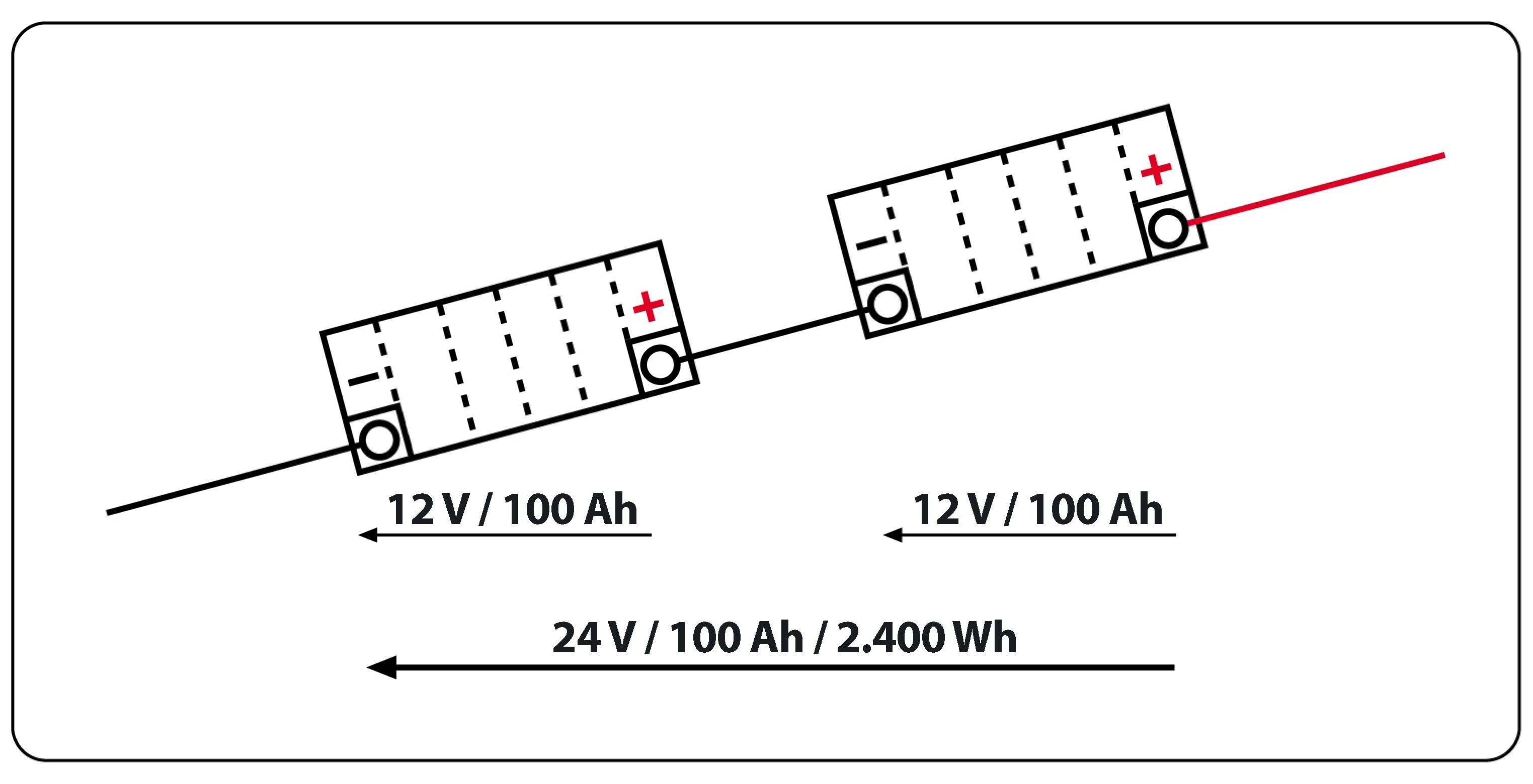
In a series connection, the voltages of the individual batteries add up. For example, to create a 24-volt electrical system, two 12-volt batteries must be connected in series. The following calculation example is based on a battery capacity of 100 Ah (K5):
Example: Two 12 V batteries, each with a capacity of 100 Ah, connected in series result in a 24 V system with an energy capacity of 24 V × 100 Ah = 2,400 Wh.
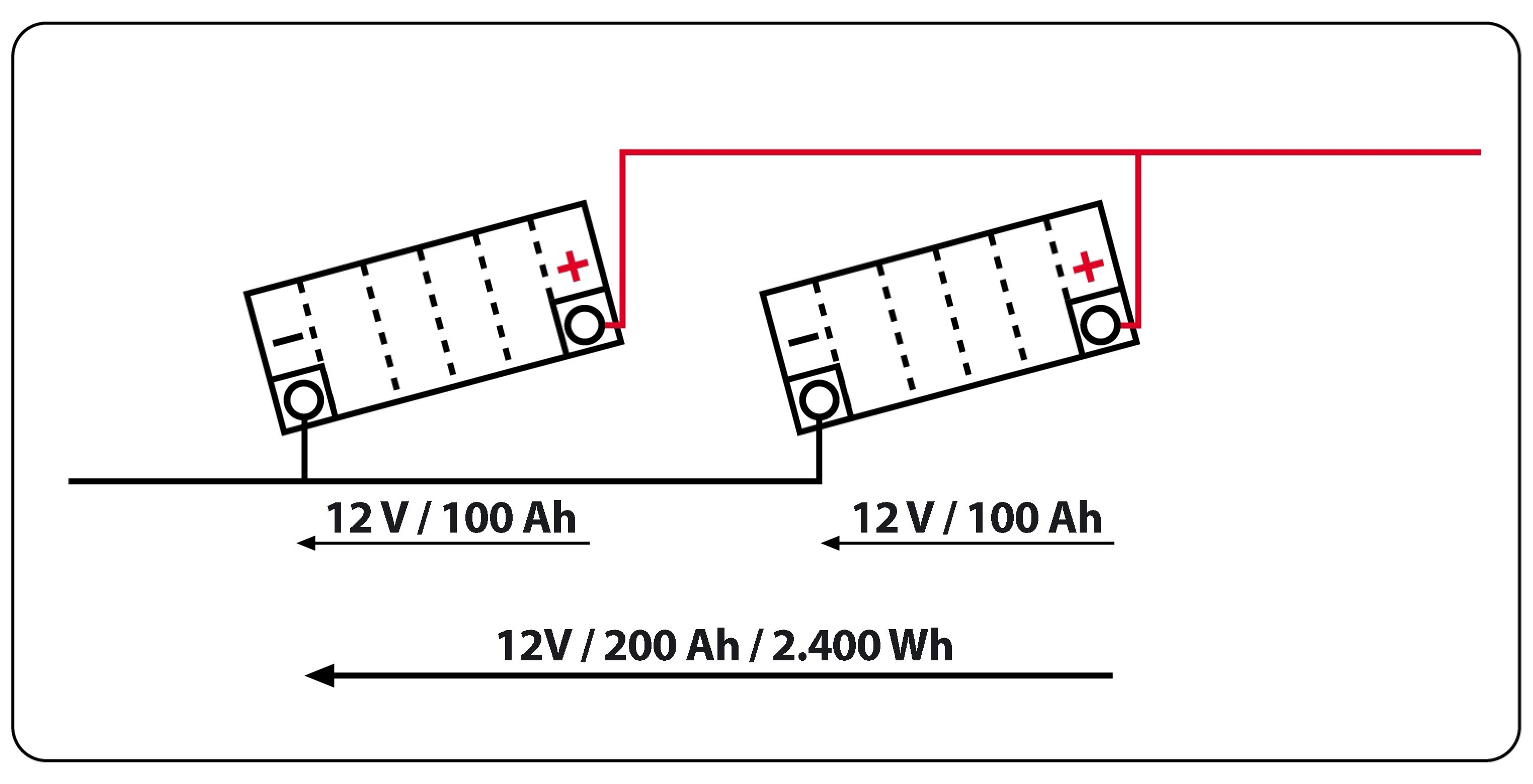
In a parallel connection, the capacities of the individual batteries add up, while the voltage remains constant.
Example: Two 12-volt batteries, each with a capacity of 100 Ah, connected in parallel result in a 12-volt system with a capacity of 200 Ah. The stored energy is therefore:
12 V × 200 Ah = 2,400 Wh.
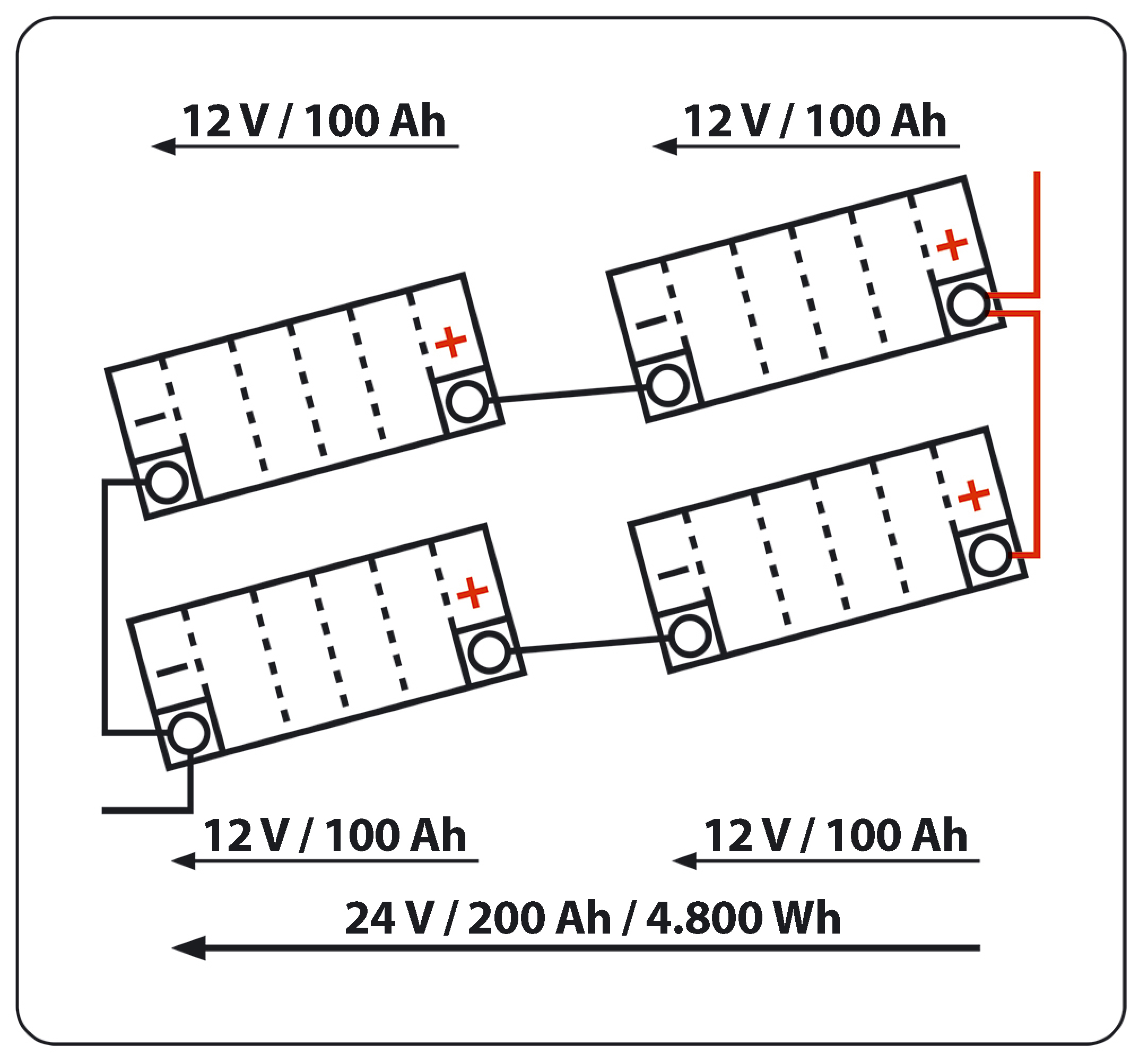
In a combination of series and parallel connections, both the voltages and the capacities of the batteries are added together.
Example: Four 12 V batteries, each with 100 Ah:
Two batteries are connected in series → 24 V / 100 Ah
Two such series strings are connected in parallel → 24 V / 200 Ah
The stored energy is therefore:
24 V × 200 Ah = 4,800 Wh.
Important notes for operating multiple batteries
Same type: All batteries used must have the same model designation, i.e., identical voltage and capacity.
Age of the batteries: Batteries should be approximately the same age.
State of charge: All batteries must have the same state of charge.
Connecting cables: Cables must be sufficiently sized and kept as short as possible.
Replacing batteries: Always replace all batteries at the same time.
Watt-hours: The total energy (Wh) remains the same regardless of whether the batteries are connected in series or in parallel.
Recommended procedure for series and parallel connections
To minimize voltage differences between the batteries and ensure optimal performance, the following steps should be followed:
Fully charge each battery individually to 100% state of charge.
Then let the batteries rest together for 12–24 hours (without load and without charging) so that the cell voltages equalize.
First connect the batteries in series.
Only once the series strings are fully charged may these strings be connected in parallel with each other.
Notes on Non-Compliance
If the above recommendations are not followed, differences in the internal resistance of the batteries can lead to uneven current distribution and thus to asymmetrical loading during charging and discharging phases.
In parallel connections, high equalizing currents can flow between the batteries.
If possible, it is recommended to use a single battery with higher capacity to avoid such problems.
No, directly connecting a LiFePO₄ battery in parallel with a lead-acid battery (flooded, AGM, or GEL) is not recommended. Due to differences in open-circuit voltage, internal resistance, and charging characteristics, this can lead to uncontrolled equalization currents and uneven loading of the batteries. In a dual-battery system, LiFePO₄ and lead-acid batteries may therefore only be connected via suitable isolation relays, charge boosters, or DC/DC converters—direct parallel connection is not permitted.
Maintenance and Storage
The battery is maintenance-free, apart from keeping the case clean and dry and removing dirt from the terminals. Lithium batteries are characterized by significantly lower self-discharge compared to lead-acid batteries, which is why the use of a trickle charger is not necessary.
For extended periods of inactivity (e.g., winter storage), we recommend the following procedure:
Charge the battery to 50–70% of its capacity before storage.
Disconnect the charger and all devices from the power supply.
For first use after purchase: Charge the battery to approximately 70–90%.
For first use after prolonged inactivity: Fully charge the battery.
Storage temperatures:
A dry, cool location with temperatures between +10°C and +25°C is recommended for storage. According to the technical data sheets, the maximum permissible storage temperature is between −5°C and +35°C. Extreme temperatures can significantly reduce the battery’s service life.
Use in cold winter weather
Operating and Storage Temperatures for LiFePO₄ Batteries
Unlike lead-acid batteries, LiFePO₄ batteries do not suffer any significant loss of capacity at low temperatures. All Banner lithium-ion batteries have a discharge operating temperature range of −20°C to +60°C. Optimal ambient temperature during charging, as noted:
- Types LFP 12-80 BL and LFP 12-100 BL (with heating function): −20°C to +60°C
- Types LFP 12-50 BL, LFP 12-75 BL, and LFP 12-150 BL (without heating function): 0°C to +60°C
Storage temperatures:
A dry, cool location with temperatures between +10°C and +25°C is recommended for storage. According to the technical data sheets, the maximum permissible storage temperature ranges from −5°C to +35°C. Extreme temperatures can significantly reduce the battery’s service life.
Comparison with lead-acid batteries:
A lead-acid battery loses up to 50% of its capacity at sub-zero temperatures, while the capacity loss in lithium batteries is significantly lower.
Tips for winter operation:
Check the battery’s charge level more frequently, as the available capacity may be slightly reduced in cold weather.
Do not charge at temperatures below 0°C, except for the LFP 12-80 BL and LFP 12-100 BL models with an integrated heating function.
If a battery without a heating function is charged in freezing conditions, the best time to do so is immediately after use, as the battery warms up slightly during use, making charging possible.