








On the road too: safely charging the leisure battery via the alternator
Why a simple cable is no longer enough with lithium.


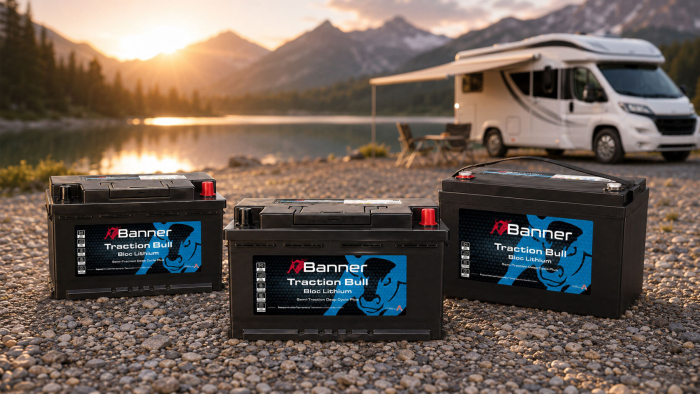
Lithium batteries are extremely worthwhile for caravan users. However, they need to give up one familiar practice: the cable length between the starter battery and the leisure battery can prove an issue. With a lithium leisure battery, this connection reaches its technical limits while driving, with consequences for the vehicle electronics, charging quality and, in the worst case, the service life of the alternator.
Lithium batteries and alternators: a special relationship
Alternators are designed for short, varying load peaks, not for hours of continuous load such as that drawn by a large lithium battery when recharging
• Lithium cells draw significantly more current than lead-acid batteries and maintain this high charging current for a longer period. As a result, the alternator operates in the upper load range for longer.
• Modern vehicles with intelligent alternator control deliberately reduce the charging voltage while driving to save fuel. This voltage is often insufficient to charge a lithium battery efficiently
• Long cable runs between the towing vehicle and caravan cause additional voltage drops, resulting in even less charging voltage reaching the leisure battery.

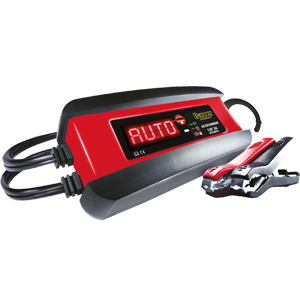
The better connection: a DC-DC charger (charging booster)
A DC-DC charging booster electrically isolates the leisure battery from the starter battery and converts the vehicle electrical system voltage into a multi-stage charging profile optimised for lithium batteries. It limits the charging current to a level that is safe for the alternator, compensates for voltage drops along the supply cable and reliably detects whether the engine is running, ensuring that the starter battery is never unintentionally discharged.
• Protects the alternator through defined current limiting designed for continuous loads.
• Provides a suitable charging profile for LFP batteries regardless of the towing vehicle’s electrical system voltage.
• Operates reliably even with the intelligent alternator control systems used in modern vehicles.
• Can be combined with solar or shore power charging without the charging sources interfering with each other. For solar PV systems, an MPPT controller is ideally suited to maximise energy yield.
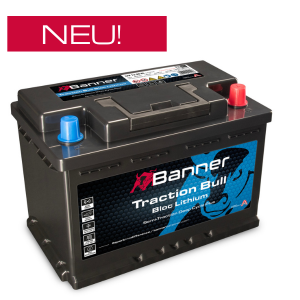
Recommended sizing for the Traction Bull Bloc Lithium range
|
Battery capacity
|
Recommended charging current | Suitable charger (guideline) |
|
Traction Bull Bloc Lithium LFP 12-50 / 12-75 BL
|
15–20 A |
DC-DC charging booster, 20 A class |
|
Traction Bull Bloc Lithium LFP 12-80 / 12-100 BL
|
20–30 A |
DC-DC charging booster, 30 A class |
|
Traction Bull Bloc Lithium LFP 12-150 BL
|
30–40 A |
DC-DC charging booster, 40 A class |
Banner tip
The values are practical guidelines only; the final configuration depends on the vehicle alternator, cable cross-section and desired charging time while driving. When switching to lithium, taking the charging system into account as well protects the towing vehicle’s alternator and ensures that the leisure battery recharges reliably while on the road instead of remaining discharged for days.