


Lithium, AGM or GEL: Which technology is right for your boat?
Three technologies, three application profiles.


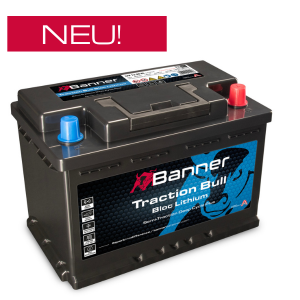
Not every boat needs lithium. AGM and GEL batteries still have their place. The question is which technology best suits specific which usage profiles. Lithium iron phosphate, or LiFePO4 for short, is a particularly stable variant of lithium-ion technology and forms the basis of the Traction Bull Bloc Lithium range.
The clearest difference lies in the usable capacity. For a long service life, lead-acid and AGM batteries should generally not be discharged beyond 50 percent, meaning that only around half of their nominal capacity is available for everyday use. A lithium battery can be discharged significantly further before the integrated Battery Management System intervenes.
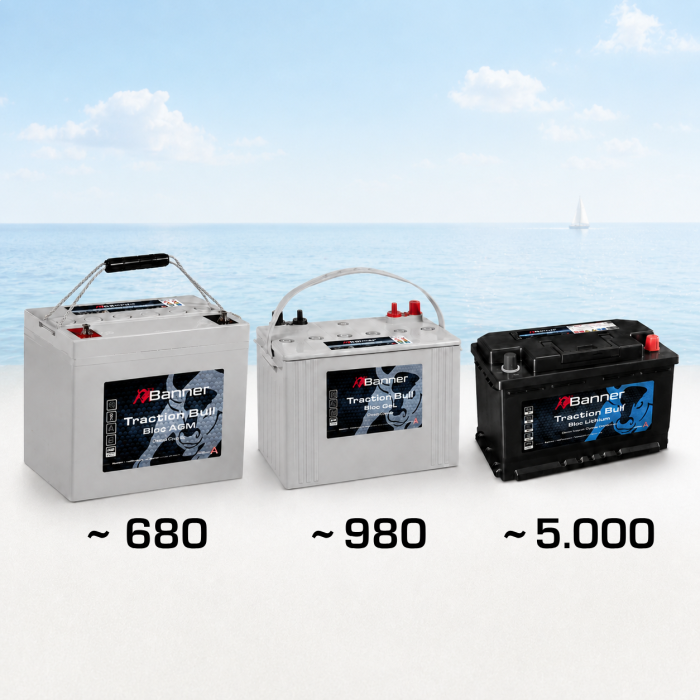
As a result, a 100 Ah lithium battery provides almost twice as much usable energy as a 100 Ah AGM battery with the same nominal capacity. There are also significant differences in cycle life:
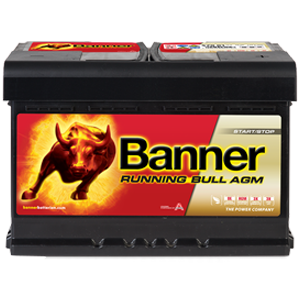
AGM battery, deep cycle: up to 680 cycles at 50 percent depth of discharge
GEL battery, deep cycle: up to 980 cycles at 50 percent depth of discharge
Traction Bull Bloc Lithium: at least 5,000 cycles at 50 percent depth of discharge, seven times more than a comparable AGM battery
Another advantage is weight: A 100 Ah Traction Bull Bloc Lithium weighs 10.9 kg, around one-third as much as a comparable lead-acid or AGM battery with the same capacity. On a smaller boat, this results in noticeably more freeboard.
Nevertheless, AGM and GEL remain the right choice for certain usage profiles:
AGM is well suited to applications with occasional high power demands, such as inverters, coffee machines, induction hobs or kettles.
GEL is the right choice for low, continuous power consumption over longer periods, for example for battery monitors, cameras, lighting or USB charging.
Banner tip
For maximum service life with AGM and GEL batteries, a depth of discharge of around 50 percent is recommended as a guideline for regular operation. Repeated discharge beyond approximately 70 percent noticeably reduces service life and usable capacity.
The choice of technology on board should therefore be based not on trends, but on your individual usage profile: occasional trips with periods of high power demand, continuous operation of small electrical loads or maximum off-grid capability for several days. The Traction Bull Bloc Lithium range is designed for the latter.